
Warehouse Slotting ROI: Track Savings With Slot3D

Warehouse slotting optimization often begins with a strong engineering analysis: identify inefficient product locations, reduce picker travel, improve throughput, and recommend better inventory placement. But recommendations alone do not create value.
Value is created when the operation executes the right moves, sustains the new process, and can clearly see the impact on labor and operating cost.
That is where Slot3D ROI tracking changes the conversation. By connecting recommended slotting actions with the moves that will actually impact the facility, each move suggestion is tied to an economic savings value. Slot3D helps warehouse teams turn optimization into a repeatable operating discipline. The result is more natural change management, greater standardization, and a stronger connection between engineering strategy and day-to-day operations.
The Gap Between Warehouse Slotting Recommendations and Realized ROI
Many warehouse slotting initiatives struggle after the initial analysis is complete.
Engineering may identify hundreds or thousands of opportunities to reduce travel and improve picking productivity. Operations may agree that the recommendations make sense. Yet execution can slow down once those recommendations encounter the realities of the distribution center:
Labor must be balanced across receiving, replenishment, picking, shipping, and inventory control.
Peak periods and service requirements can limit time available for re-slotting work.
Teams may prioritize urgent moves over economically valuable moves.
Recommended moves can become disconnected from daily operating routines.
Leaders may not have a clear view of whether slotting activity created measurable savings.
In these situations, the issue is the lack of a shared process for converting recommendations into prioritized work, completed moves, and verified business value. Slot3D addresses that gap with economic move suggestions and takes it a step further ROI tracking that measures both execution and economic impact using the facility’s own data.
What Slot3D ROI Tracking Measures
Slot3D’s ROI scenario compares what the optimizer recommended, what the facility actually moved, and the operational savings captured during a defined ROI window.
Rather than treating all inventory moves as equal, Slot3D distinguishes between activity and value. It shows whether moves aligned with recommended actions, whether those actions were economically beneficial, and how much additional savings remains available.

The ROI framework includes six connected measures:
Slot3D ROI KPI | Business Question It Answers |
Moves Aligned With Slot3D Suggestion | Did the facility execute moves that matched Slot3D recommendations? |
Operational Savings ($) | How much real operating cost reduction did the facility capture? |
% Savings-Bearing Suggestions Executed | How effectively did the operation execute high-value recommendations? |
Moves With Operational Savings | How many completed moves directly created measurable savings? |
Unexecuted Savings-Bearing Suggestions | How many valuable move opportunities remain open? |
Unrealized Operational Savings ($) | How much additional cost reduction is still available? |
This gives facilities visibility into both the value already realized and the value still available for future execution.
Why Savings-Bearing Execution Matters
The most important adoption measure in Slot3D is the percentage of savings-bearing suggestions that were executed.
A savings-bearing suggestion is a move where the expected operational benefit exceeds the cost of completing the physical move. In practical terms, these are the moves that should make the warehouse more efficient after accounting for the labor and effort required to re-slot the inventory.
A facility may execute hundreds of physical moves in a week, but if those moves are reactive, manually directed, or disconnected from Slot3D's highest-value recommendations, the operation may not be capturing the available ROI. By contrast, a smaller number of well-prioritized savings-bearing moves can produce a stronger financial result.
Slot3D allows teams to move from asking:
How many moves did we complete?
To asking:
How much operational value did the moves we completed create?
That shift supports better prioritization, stronger adoption, and more productive use of limited labor capacity.
Natural Change Management Through Visibility
Change management is most effective when it is embedded in the work teams already perform.
Slot3D ROI tracking supports natural change management because it does not require warehouse teams to adopt optimization recommendations on faith. Instead, it gives teams a feedback loop between action and outcome.
When a team completes a recommended move, Slot3D can show whether that move aligned with Slot3D's guidance and whether it contributed to measurable operational savings. When a valuable recommendation is not completed, the facility can see the remaining opportunity and decide whether to schedule it later.
This makes change management practical rather than theoretical.
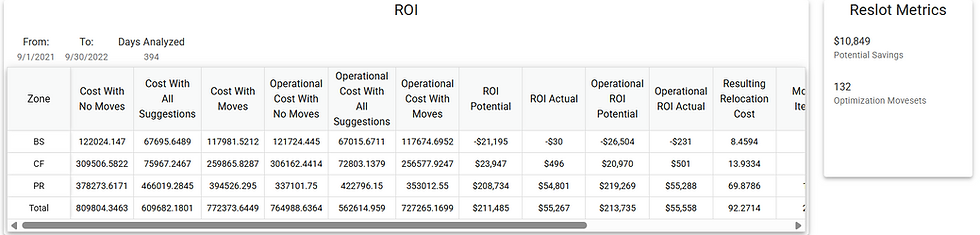
Engineering gains feedback from the floor
Engineering teams can see whether recommendations are being executed and where execution may be constrained.
For example, if a zone consistently has a high number of unexecuted savings-bearing suggestions, engineering can investigate the reason.
This feedback makes the optimization process stronger over time. Engineering is no longer handing off a static list of moves. Instead, engineering receives real operational insight that can improve future recommendations.
Operations gains a prioritized improvement queue
Operations teams are responsible for executing work in a live environment where customer commitments, shipping cutoffs, inbound volume, replenishment demands, and staffing levels change constantly.
Slot3D provides a way to prioritize slotting work based on financial impact. Instead of treating every suggested move as equally urgent, supervisors and warehouse leaders can focus on the actions with the strongest positive return.
This allows slotting work to fit naturally into daily and weekly routines. Teams can complete high-value moves when labor capacity is available and return to the remaining opportunity when operational conditions allow.
The goal is not to force every recommendation into the operation immediately. The goal is to establish a consistent pattern of executing the most valuable moves first.

Leadership gains a shared view of value
Warehouse leaders need more than a list of recommendations or an activity count.
They need to understand whether the program is being adopted and whether it is producing a measurable return.
Slot3D ROI tracking gives leadership a common scorecard across engineering and operations:
How much operational savings has the facility captured?
What percentage of high-value recommendations were executed?
Where are the largest remaining savings opportunities?
Which zones have strong adoption and which need attention?
Are completed inventory moves contributing to a sustained reduction in operating cost?
This shared visibility helps leaders support slotting as an ongoing improvement program rather than a periodic cleanup project.
Standardizing Slotting Across the Facility
Standardization is one of the most important benefits of tracking slotting ROI.
Without a standard process, slotting decisions can vary by shift, supervisor, zone, facility, or individual experience level. One team may prioritize travel reduction, another may prioritize available space, and another may make moves based on urgent conditions without visibility into the broader operating-cost impact.
Slot3D creates a repeatable workflow for managing slotting decisions:
Slot3D identifies inventory moves with savings potential.
Teams prioritize the recommendations with a positive net operational benefit.
Operations executes the moves based on labor capacity and facility priorities.
Slot3D tracks which moves matched the recommendations.
The facility measures actual operational savings.
Engineering and operations review remaining high-value opportunities
Slot3D's automated data refreshes allow for updated slotting plans
This process creates consistency without ignoring the realities of warehouse operations.
Connecting Engineering and Operations
Slotting has traditionally sat between two necessary but sometimes disconnected perspectives.
Engineering focuses on the analytical opportunity: reducing travel, improving pick density, balancing inventory placement, and lowering the modeled cost of the operation.
Operations focuses on execution: completing physical moves safely, maintaining service levels, managing labor, and responding to the changing needs of the facility.
Neither perspective is complete on its own.
Slot3D ROI tracking connects the two by giving both teams the same definitions of success. Engineering can see whether recommendations are practical and adopted.
Operations can see that move work contributes to measurable financial outcomes.
Leadership can see where the operation is capturing value and where additional opportunity remains.
Engineering Needs | Operations Needs | How Slot3D Connects Them |
Identify high-value slotting opportunities | Prioritize limited labor and move capacity | Highlights moves recommendations with $ savings |
Confirm recommendations are being adopted | Execute practical, manageable work | Tracks moves aligned with Slot3D suggestions |
Measure the modeled benefit of different slotted locations | See whether work improved facility economics | Measures operational savings captured |
Improve recommendation quality over time | Surface barriers to execution | Reveals unexecuted high-value opportunities |
Build a continuous-improvement process | Avoid one-time, disruptive re-slotting projects | Creates a recurring slotting optimization initative |
This shared KPI structure helps replace opinion-based debates with operational evidence.
Instead of asking whether a recommendation was theoretically correct, teams can ask whether it was executed, whether it produced value, and what needs to happen for the next high-value opportunity to be completed.
From One-Time Project to Continuous Improvement
The strongest slotting programs are not defined by a single optimization event. They are defined by a continuing cycle of improvement.
Slot3D supports that cycle by making ROI visible after recommendations are generated. Facilities can see which opportunities were captured, which remain available, and how the economics of the operation change as teams execute better slotting decisions.
For example, a warehouse may identify $150,000 in total operational ROI potential during a slotting scenario. If the team completes the highest-value recommendations first and captures $60,000 in operational savings during the initial ROI window, Slot3D makes both outcomes visible:
$60,000 in realized operational savings shows the value already captured.
$90,000 in unrealized operational savings shows the remaining opportunity.
The remaining savings-bearing suggestions become a prioritized work backlog rather than an outdated recommendation list.
That visibility changes how teams manage slotting. The conversation shifts from “Why have we not finished every move?” to “Which remaining moves will create the next highest return?”
As your demand shifts, data changes, Slot3D can anlayze this information and produce new slotting suggestions based on the latest data and operational benefits to be realized in the current state. Operations is working from a new, refreshed moves list.
Building a Sustainable Slotting Operating Model
To make Slot3D ROI tracking part of a sustainable operating model, facilities should establish a simple recurring routine.
Review savings-bearing recommendations by zone, work area, or operational priority.
Assign realistic execution capacity based on current labor and volume conditions.
Review completed moves and alignment with Slot3D recommendations.
Measure actual operational savings captured during the ROI window.
Review unexecuted high-value recommendations and their unrealized savings value.
Investigate recurring execution barriers and use those insights to improve planning, slotting logic, and operational coordination.
Share ROI progress with warehouse leadership, engineering, and operational stakeholders.
This process helps facilities create accountability without creating unnecessary administrative overhead. It also ensures that improvement work remains focused on the moves that produce meaningful business value.
The Bottom Line
Slot3D ROI tracking makes warehouse slotting more than an optimization exercise. It creates a shared, measurable process for turning recommendations into operational behavior and operational behavior into financial results.
By tracking recommendation alignment, savings-bearing execution, captured operational savings, and unrealized opportunity, Slot3D helps facilities:
Make slotting change management more natural and less disruptive.
Standardize how teams prioritize and execute inventory moves.
Connect engineering recommendations to warehouse-floor activity.
Give leadership clear visibility into actual and remaining ROI.
Build a continuous-improvement process that adapts to real operating conditions.
When every completed move can be connected to its operational impact, slotting becomes easier to adopt, easier to manage, and easier to sustain.
Frequently Asked Questions
What is Slot3D ROI tracking?
Slot3D ROI tracking compares the moves it recommends with the moves your facility actually completes. It then measures the operational savings captured and the remaining savings opportunity.
How does Slot3D measure slotting ROI?
Slot3D evaluates executed inventory moves, move alignment with its recommendations, and the resulting operational cost impact during a defined ROI window. This shows both actual savings captured and potential savings still available.
What is a savings-bearing suggestion?
A savings-bearing suggestion is a recommended move where the expected operational savings exceed the cost of performing the move. These are the highest-priority moves because they produce a positive net return.
Why track moves aligned with Slot3D suggestions?
This KPI shows whether warehouse execution is following Slot3D’s recommended slotting strategy. It helps distinguish high-value, Slot3D-aligned work from general or reactive inventory movement.
How does Slot3D support change management?
Slot3D gives engineering and operations a shared view of recommended actions, completed work, and financial results. This makes slotting change more practical, measurable, and easier to sustain over time.
How does Slot3D standardize slotting?
Slot3D creates a repeatable process to identify high-value moves, prioritize them, execute them when capacity allows, and measure the result. This reduces reliance on tribal knowledge and creates a consistent slotting discipline across shifts, zones, and facilities.
How often should teams review Slot3D ROI?
Many facilities benefit from a weekly or monthly review, but depending on volume and how quickly the inventory profile changes some operations perform daily reslotting activities. The key is to regularly evaluate captured savings, completed recommendations, and the remaining high-value backlog.


Comments